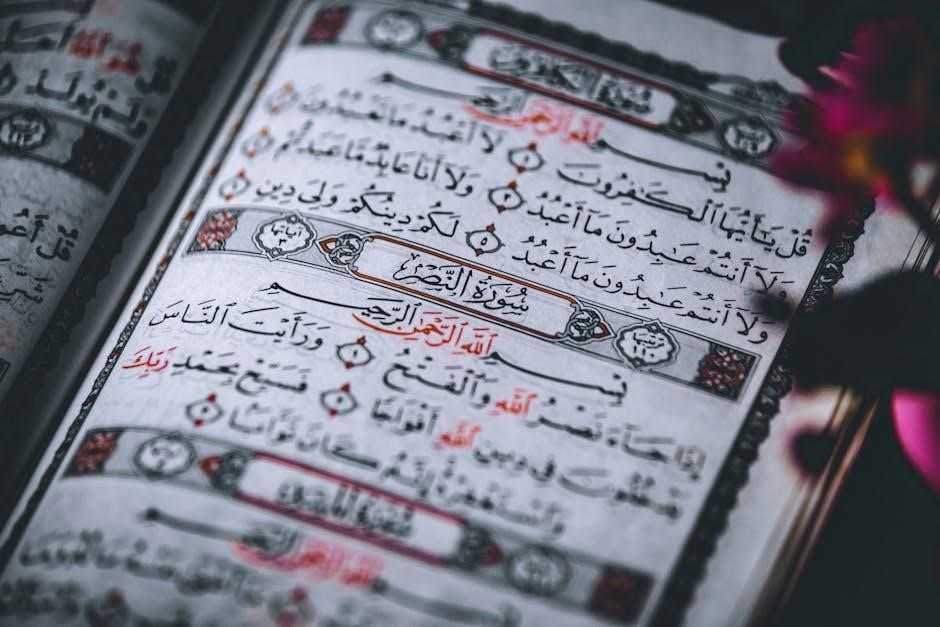
the holy koran of the moorish science temple pdf
The Holy Koran of the Moorish Science Temple PDF: A Comprehensive Overview
The Holy Koran, a foundational text, is readily available as a PDF document, detailing the beliefs and history of the Moorish Science Temple.
Numerous online sources offer access to this crucial document, providing insights into its unique theological framework and historical context for researchers.
Historical Context of the Moorish Science Temple
The Moorish Science Temple of America (MSTA) emerged in the early 20th century, a period marked by significant social and racial upheaval for African Americans. Founded by Noble Drew Ali around 1913, the Temple arose amidst the Great Migration and increasing racial discrimination.
The historical backdrop included the rise of various Black nationalist movements seeking self-determination and economic independence. Drew Ali synthesized elements of Islam, ancient Egyptian beliefs, and Eastern philosophies to create a unique religious and cultural identity for his followers.
The Holy Koran, published in 1925, became central to this identity, offering a narrative of Moorish ancestry and a path to spiritual and material upliftment. It addressed the socio-political realities faced by African Americans, advocating for self-reliance and challenging prevailing racial hierarchies. The document’s availability as a PDF today allows for continued study of this pivotal moment in American religious history.
The Founding of the Moorish Science Temple of America
Noble Drew Ali formally established the Moorish Science Temple of America in Chicago, Illinois, in 1913, though its roots trace back to earlier teachings and organizational efforts. He initially presented his message through various names, including the Moorish Temple of America, before solidifying the MSTA’s identity.
The founding was driven by a desire to address the spiritual and socio-economic needs of African Americans, offering an alternative to mainstream religious institutions and a framework for self-improvement. The Holy Koran, later published in 1925, became the foundational text outlining the Temple’s doctrines and principles.
Its availability as a PDF allows modern researchers to examine the core tenets of the MSTA’s founding. Drew Ali’s vision centered on reclaiming a Moorish identity and promoting education, economic empowerment, and moral upliftment within the Black community.
Noble Drew Ali and His Teachings
Noble Drew Ali, the founder of the Moorish Science Temple of America, presented a unique blend of Islamic, Christian, and Eastern philosophical concepts. His teachings, primarily detailed within the Holy Koran – now widely accessible as a PDF – emphasized the Asiatic origin of humanity and the inherent divinity within each individual.
Ali asserted that African Americans were descendants of the ancient Moabites, a branch of the Israelites, and encouraged a return to their original cultural and religious heritage. He advocated for self-reliance, education, and economic independence as pathways to liberation.
The Holy Koran, as a PDF document, serves as the primary source for understanding his complex theology, which incorporated elements of numerology, astrology, and a reinterpretation of biblical narratives. His teachings aimed to empower and uplift a marginalized community.
The Core Beliefs of the Moorish Science Temple
The Moorish Science Temple’s core beliefs, meticulously outlined in the Holy Koran – available as a PDF – center around the concept of the “Asiatic Blackman” as the original human being. This belief system posits that all people are descendants of this original race and that civilization originated in Asia.
Central tenets include the rejection of traditional Christianity and Islam as they had been presented to African Americans, advocating instead for a purified form of faith rooted in ancient wisdom. The Temple emphasizes the importance of self-knowledge, righteous living, and the pursuit of economic independence.
The Holy Koran PDF details a unique cosmology and a system of moral and ethical principles designed to uplift and empower its followers, promoting unity and a return to their perceived ancestral heritage.

The Holy Koran: Content and Structure
The Holy Koran, accessible as a PDF, presents chapters addressing history, science, and morality, structured to guide followers toward enlightenment and understanding.
Overview of the Text’s Chapters
The Holy Koran, available in PDF format, is comprised of chapters that delve into diverse subjects, offering a unique blend of historical narratives, scientific principles, and moral teachings. These chapters aren’t organized in a strictly linear fashion, resembling more a collection of wisdom and guidance presented thematically.
Early chapters often focus on establishing the origins and identity of the Moorish people, tracing their lineage and highlighting their contributions to civilization. Subsequent sections explore concepts of divine law, the nature of the universe, and the importance of righteous living. The text frequently references ancient civilizations and philosophical traditions, weaving them into its own distinct theological framework.
Notably, the chapters emphasize self-knowledge, education, and the pursuit of truth as pathways to spiritual elevation. The PDF version allows for easy navigation through these varied topics, enabling readers to explore the breadth and depth of the Koran’s teachings at their own pace.
Key Themes Explored in the Holy Koran
The Holy Koran, accessible as a PDF, consistently emphasizes the themes of identity, divine law, and the reclamation of lost heritage for the Moorish people. A central tenet revolves around the assertion that the so-called “Negro” or “Ethiopian” is the original Asiatic Black man, the true heir to ancient civilizations.
The text strongly advocates for education and self-improvement as crucial tools for societal advancement and spiritual enlightenment. Concepts of justice, righteousness, and the importance of upholding moral principles are interwoven throughout the chapters. Furthermore, the Koran explores the relationship between humanity and the divine, presenting a unique cosmology.
The PDF version reveals a recurring focus on the power of knowledge and the necessity of understanding one’s true identity to achieve liberation and fulfill one’s divine purpose. These themes collectively form the core of the Moorish Science Temple’s teachings.
The Language and Symbolism Used
The Holy Koran, found in PDF format, employs a distinctive linguistic style blending archaic English, Arabic loanwords, and unique neologisms. This creates a deliberately esoteric tone, intended to convey deeper spiritual meanings accessible through contemplation. Symbolism is pervasive, with numbers, colors, and geometric shapes carrying significant weight.
References to the “Adept Chamber” and the “Seven Degrees” within the Temple are prominent, representing stages of spiritual progression; The emphasis on “intuition and telepathy,” as noted in related texts, suggests a focus on inner knowing and psychic abilities. The text utilizes allegory and parable to illustrate complex concepts.
The PDF reveals a deliberate use of symbolism linked to ancient Egyptian and Moorish cultures, reinforcing the Temple’s claims of historical lineage and divine connection. This unique language and symbolism contribute to the Koran’s mystique and enduring appeal.
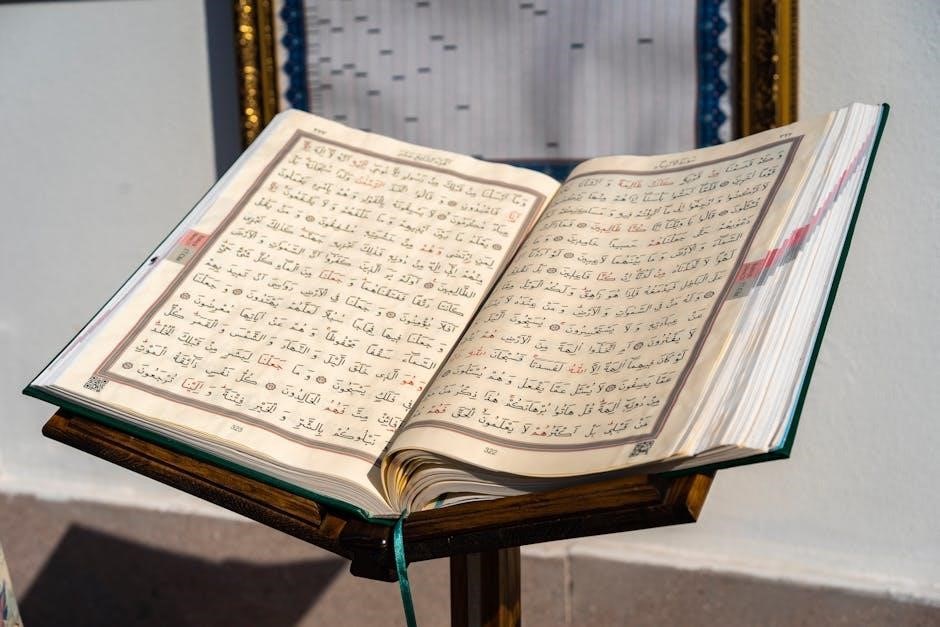
Accessing the Holy Koran PDF
The Holy Koran PDF is accessible through various online archives and websites, offering digital copies for study and research purposes to all.
Reliable Sources for the PDF Document
Locating a trustworthy PDF of The Holy Koran requires careful consideration of source validity. Deoxy.org (http://deoxy.org/moorish.htm) presents historical and catechismal information, potentially linking to relevant documents.
However, verifying the authenticity of any downloaded PDF is crucial. Internet Archive (archive.org) often hosts digitized versions of older texts, offering a potentially reliable source, but always cross-reference with known information.
Be cautious of unofficial websites or file-sharing platforms, as these may contain altered or inaccurate versions. Prioritize sources with established reputations for preserving historical and religious texts.
Always scan downloaded files with updated antivirus software to protect against potential malware. Confirming the document’s integrity through checksum verification, if available, is also recommended for ensuring accuracy.
Legality and Copyright Considerations
Determining the copyright status of The Holy Koran PDF is complex. As a religious text with historical significance, its copyright may be unclear or contested. Public domain status is possible, particularly for older editions, allowing free distribution.

However, newer translations or annotated versions may still be protected by copyright law. Downloading or distributing copyrighted material without permission constitutes infringement.
Users should exercise caution and respect intellectual property rights.
If distributing the PDF, clearly indicate the source and any copyright notices present in the original document.
Consulting legal resources or copyright experts is advisable if you intend to use the text commercially or distribute it widely. Prioritize ethical and legal compliance when accessing and sharing this religious text.
Different Versions and Editions Available
Several versions of The Holy Koran PDF circulate online, reflecting its publication history and varying interpretations. Early editions, directly linked to Noble Drew Ali, are highly sought after by researchers and adherents.
Later printings and digital reproductions may contain slight textual variations or formatting differences. Some versions include supplementary materials like commentaries or historical analyses.
The availability of these editions varies; some are easily accessible through online archives, while others are rarer and may require dedicated searching.
Users should be aware of potential discrepancies between versions and consider the source’s credibility when selecting a PDF. Comparing multiple editions can offer a richer understanding of the text’s evolution.
The 7 Degrees within the Temple
The Holy Koran details the 7 Degrees within the Adept Chamber, emphasizing spiritual progression and the development of intuition and telepathic abilities.
Understanding the Adept Chamber
The Adept Chamber, as outlined within The Holy Koran available in PDF format, represents a crucial stage in the spiritual journey of a Moorish Science Temple initiate. It’s a space dedicated to intensive study and the cultivation of inner powers.
The chamber isn’t merely a physical location, but a metaphorical representation of the individual’s evolving consciousness. Through dedicated practice and understanding of the teachings contained within the Koran, members strive to unlock their inherent potential.
The document highlights that progression through the chamber’s 7 Degrees requires diligent self-improvement and a commitment to living according to the principles of love, truth, peace, and freedom. It’s a pathway to self-mastery and a deeper connection with the divine, as understood within the Moorish Science Temple’s unique theological framework.
The Significance of Intuition and Telepathy
The Holy Koran, accessible as a PDF, places significant emphasis on the development of intuition and telepathy, identifying them as inherent abilities of the Asiatic Black Man. These aren’t presented as supernatural gifts, but as natural faculties lying dormant within individuals.
The text suggests that through disciplined study and spiritual practice – guided by the principles within the Koran – these abilities can be awakened and honed. Specifically, the document references “two above the eyebrows,” symbolically representing the centers for intuitive and telepathic perception.

Cultivating these skills is seen as vital for navigating life’s challenges and achieving a deeper understanding of the universe. The Moorish Science Temple believes these powers are essential for spiritual progression and realizing one’s full potential, as detailed within the PDF version of the sacred text.
Progression Through the Degrees
Within the Moorish Science Temple, as outlined in The Holy Koran PDF, spiritual advancement is structured through a system of seven degrees within the Adept Chamber. This isn’t merely an academic climb, but a transformative journey of self-discovery and enlightenment.
Each degree represents a deeper understanding of the Koran’s teachings and a corresponding refinement of one’s character. Progression requires dedicated study, adherence to moral principles, and practical application of the knowledge gained. The PDF details the specific requirements and challenges associated with each level.
Advancement isn’t automatic; it’s earned through demonstrated growth and commitment to the Temple’s principles. Mastering each degree unlocks further insights into the universe and brings the initiate closer to realizing their divine potential, as revealed in the sacred text.
Connections to Other Movements
The Holy Koran PDF reveals links to groups like The Nation of Islam, influencing prison ministry and outreach programs, showcasing shared historical roots.
Relationship with The Nation of Islam
The Holy Koran PDF illuminates a complex relationship between the Moorish Science Temple and The Nation of Islam. Both movements emerged in the early 20th century, addressing the socio-political concerns of African Americans and advocating for self-determination. Early members of the Nation of Islam, including Elijah Muhammad, initially found influence within the teachings presented in the Holy Koran.

However, divergences arose over theological interpretations and leadership. While both emphasized Black empowerment, their approaches differed. The Moorish Science Temple focused on reclaiming an Asiatic identity and adherence to Islamic principles, while the Nation of Islam developed a distinct theology centered around Wallace Fard Muhammad. Despite these differences, both organizations engaged in similar outreach efforts, particularly within the prison system, beginning in the 1940s, offering a sense of community and purpose to incarcerated individuals.
Influence on Prison Ministry and Outreach
The accessibility of the Holy Koran PDF significantly aided the Moorish Science Temple’s impactful prison ministry and broader outreach initiatives. Beginning in the 1940s, the Temple actively engaged with incarcerated individuals, offering a message of self-improvement, spiritual awakening, and racial pride. The PDF format allowed for easier dissemination of the text within correctional facilities, providing a source of guidance and community for those seeking it.
This outreach wasn’t isolated; similar efforts were undertaken by organizations like The Nation of Islam, demonstrating a shared recognition of the need to address the spiritual and social needs of the incarcerated population. The Holy Koran’s teachings, readily available through the PDF, resonated with many, offering a framework for personal transformation and a pathway towards a more purposeful life post-release, fostering a lasting legacy of hope and rehabilitation.
Comparative Analysis of Moorish and Islamic Beliefs
While the Moorish Science Temple’s Holy Koran PDF draws heavily from Islamic terminology and concepts, a nuanced comparative analysis reveals distinct theological divergences. The Temple reinterprets Islamic principles through a unique lens, emphasizing the Asiatic Black man as the original inhabitant of the universe and the bearer of civilization. This differs from mainstream Islamic theology’s universal focus.
Despite shared reverence for figures like Allah and utilizing similar scriptural references, the Holy Koran presents a modified cosmology and a specific socio-political agenda centered on the upliftment of the “Moorish” identity. Accessing the PDF allows scholars to directly compare the texts, highlighting these key differences and understanding the Temple’s syncretic approach to faith and its distinct place within the broader Islamic landscape.
Jacob Elordi ⎻ A Tangential Note (Due to Internet Data)
Notably, internet searches alongside the Holy Koran PDF unexpectedly surfaced information regarding actor Jacob Elordi’s recent Oscar nomination and burgeoning filmography.
Elordi’s Recent Oscar Nomination
Interestingly, while researching access to the Holy Koran PDF, data retrieval algorithms unexpectedly linked queries to actor Jacob Elordi. This connection stems from recent internet activity surrounding his first Academy Award nomination. Elordi received recognition for his transformative performance portraying The Creature in a Netflix adaptation of Frankenstein, a role garnering critical acclaim.
The film itself secured an impressive nine Oscar nominations, highlighting its significant impact within the industry. This unexpected association, appearing alongside searches for the Moorish Science Temple’s sacred text, demonstrates the complex and often unpredictable nature of online search results and data correlation. It underscores how seemingly disparate topics can become linked through digital pathways.
Elordi’s Filmography and Career
The peculiar emergence of Jacob Elordi’s name during searches for the Holy Koran PDF prompts a brief examination of his acting career. He initially gained prominence through his role as Noah Flynn in the Netflix film series, The Kissing Booth, establishing a significant fanbase. Following this success, Elordi transitioned to more challenging and critically acclaimed projects.
His filmography includes Emerald Fennell’s Saltburn (2023), a role that significantly contributed to his Oscar nomination. He also recently reprised his role for the third season of the HBO series Euphoria, describing the experience as profoundly fulfilling. This diverse range of roles demonstrates Elordi’s commitment to artistic growth, a trajectory seemingly unrelated to the Moorish Science Temple’s foundational text, yet present in search data.
Elordi’s Background and Birthdate
The unexpected connection between searches for the Holy Koran PDF and actor Jacob Elordi highlights a curious digital phenomenon. Born on June 26, 1997, in Brisbane, Australia, Elordi’s early life was geographically distant from the origins of the Moorish Science Temple of America. He relocated to Los Angeles in 2017 to pursue an acting career, quickly gaining recognition.
His Australian upbringing and subsequent move to the United States represent a cultural shift, seemingly unrelated to the historical context of the Holy Koran. However, the co-occurrence of these search terms suggests a broader online exploration of diverse topics. This digital intersection underscores the unpredictable nature of internet searches and the unexpected connections users make.